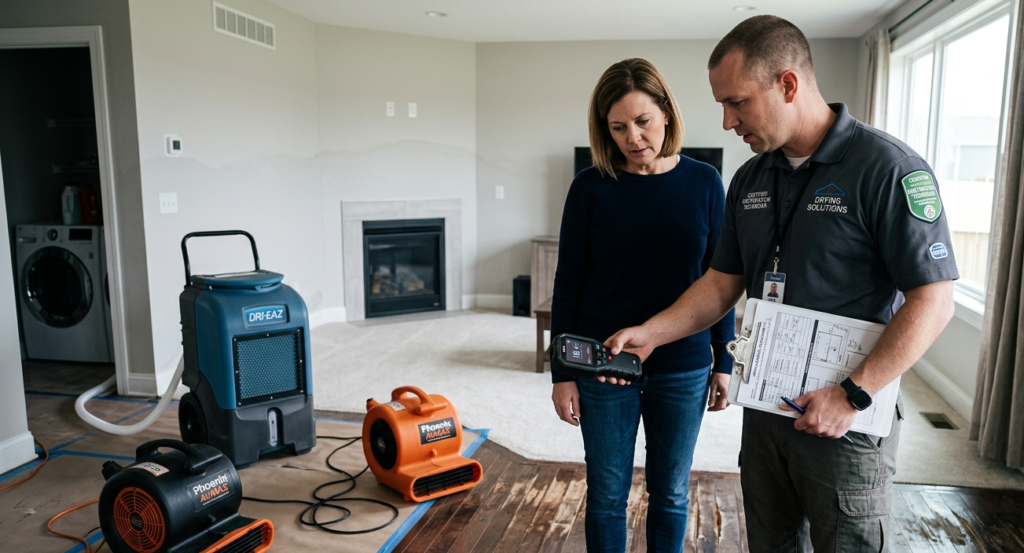
Water damage does not give you time to browse reviews at your leisure. Whether a pipe has burst behind your bathroom wall, a storm has pushed water into your basement, or a sewage backup has contaminated your first floor, the clock is running the moment the damage begins. Every hour that passes, water works deeper into flooring, drywall, and framing – and the gap between what can be saved and what must be replaced gets wider.
That urgency is exactly what some dishonest contractors count on. In the chaos that follows a flooding event, homeowners make rushed decisions and sometimes hire the wrong company – one that is unqualified, uninsured, or simply unequipped to do the job properly. The result is a property that looks dry but isn’t, mold that appears weeks later, and an insurance claim that falls apart under scrutiny.
This guide gives you a clear, practical framework for choosing a certified water damage restoration company – one you can trust with your home, your family’s health, and your insurance claim – whether you’re in Trenton, New Jersey, or anywhere else in the country.
Why Certification Matters More Than Price
The first thing most homeowners ask when calling restoration companies is: “How much will this cost?” That is a reasonable question, but it is not the most important one. The more important question is: “Are you qualified to do this correctly?”
Water damage restoration is not cleaning up water. It is a technical, multi-phase process that requires specialized equipment, professional training, and adherence to nationally recognized standards. Done incorrectly – even by well-meaning contractors who lack proper training — it leaves moisture trapped inside structural materials, which then fuels mold growth, wood rot, and ongoing deterioration that can cost far more to address later than the original damage.
Professional certification is the most reliable signal that a company understands and follows the science of proper drying. Here is what to look for.
The Most Important Certification: IICRC
The single most important credential to look for in a water damage restoration company is certification from the Institute of Inspection, Cleaning and Restoration Certification (IICRC).
The IICRC is the globally recognized standard-setting organization for the cleaning and restoration industry. Their water damage restoration standard – known as the IICRC S500 – is the technical document that defines how proper water damage mitigation is performed, from initial assessment through final dry-standard verification. It covers moisture mapping protocols, equipment placement science, drying timelines, and the documentation required to verify that structural materials have actually reached safe moisture levels.
An IICRC-certified firm has demonstrated that its technicians have completed formal training in these standards, passed certification exams, and committed to ongoing education to maintain their credentials. When you hire an IICRC-certified company, you are hiring a team that knows the difference between a property that looks dry and one that actually is – and that difference is where most post-restoration mold problems originate.
You can verify any company’s IICRC certification status directly at the IICRC’s official website: iicrc.org. This search is free, takes about 30 seconds, and protects you from companies that claim certification without holding it.
Individual technicians can also hold IICRC certifications. The most relevant for water damage are:
- WRT — Water Damage Restoration Technician: The foundational certification for water damage response
- ASD — Applied Structural Drying Technician: Advanced certification in the science of drying structural materials
- AMRT — Applied Microbial Remediation Technician: Covers mold and sewage situations that frequently follow water damage
A company that has technicians holding both WRT and ASD certifications has invested seriously in professional training. Ask for this before you sign anything.
Licensing and Insurance: Non-Negotiable Requirements
Beyond IICRC certification, two things must be verified before any contractor touches your property: state licensing and proper insurance coverage.
Licensing requirements for water damage restoration contractors vary by state. In New Jersey, contractors performing home improvement work are required to be registered with the New Jersey Division of Consumer Affairs under the Home Improvement Contractor (HIC) registration program. You can verify a contractor’s registration status at njconsumeraffairs.gov. Never hire a contractor who cannot provide their license or registration number — operating without one is illegal and signals a company that cuts corners elsewhere too.
Insurance must include two components:
- General liability insurance — Protects you if the contractor causes additional damage to your property during the restoration process
- Workers’ compensation insurance — Protects you from liability if a technician is injured working on your property
Ask for certificates of insurance before work begins, not after. A legitimate company will provide these without hesitation. If a contractor hesitates or deflects, that is your answer.
7 Questions to Ask Before Hiring Anyone
When water is sitting in your home and you are calling restoration companies, you need a fast filter. These seven questions cut through the noise:
1. Are you IICRC certified, and can I verify it? The answer should be yes, and they should offer you the IICRC certification number to look up yourself. Any hesitation is a red flag.
2. Are your technicians certified, or just the company? Company-level certification matters, but the people actually working in your home should hold individual certifications. Ask what certifications the lead technician carries.
3. Are you licensed and insured in this state? Ask for the license number and insurance certificates. Do not accept verbal assurances — ask for documents.
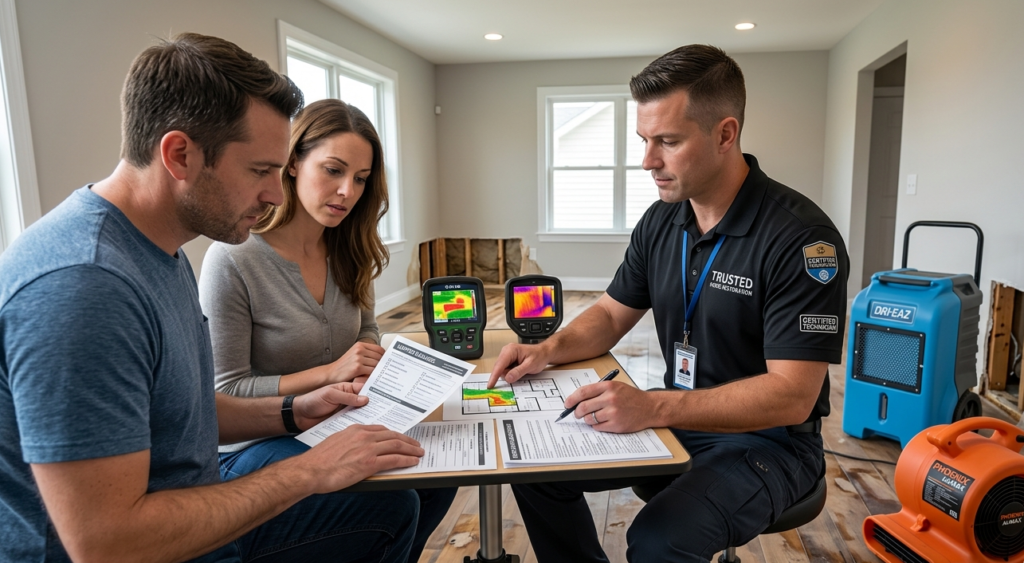
4. Do you use moisture meters and thermal imaging cameras? These are essential tools for finding hidden moisture. A company that relies on visual inspection alone will miss trapped moisture inside walls and subfloors. If they don’t own this equipment, they cannot do the job properly.
5. Will you provide daily moisture readings and a written drying report? Proper restoration includes documented moisture readings taken each day to verify that materials are drying to the IICRC standard. This documentation is also critical for your insurance claim. If a company doesn’t offer this, your claim may be harder to substantiate.
6. Do you work directly with insurance companies? Experienced restoration companies communicate directly with insurance adjusters, provide documentation in the format adjusters require, and can help you navigate the claims process. This saves you time and reduces the risk of a partial or denied claim.
7. What is your response time? Water damage restoration is emergency work. A company that cannot commit to being on-site within one to two hours for active flooding events is not equipped for genuine emergency response. Ask specifically – not “do you offer 24/7 service” but “how long until a crew is at my door tonight at 11pm?”
Red Flags That Should Make You Walk Away
Knowing what a good company looks like is half the picture. The other half is recognizing the warning signs of a bad one.
Unusually low estimates. Water damage restoration requires industrial equipment, trained labor, and multiple days of work. An estimate dramatically lower than others you’ve received almost always means something is being skipped — typically the thoroughness of drying, the moisture monitoring, or the antimicrobial treatment.
Pressure to sign immediately. Legitimate companies explain your options and give you time to make an informed decision. A contractor who pressures you to sign before you’ve verified their credentials or read the contract is using urgency as a sales tool.
No written contract or scope of work. Every legitimate restoration job should come with a written scope of work that details what will be done, what equipment will be used, and what the completion standard is. Verbal agreements leave you with no recourse if the work is incomplete.
Asking you to sign over your insurance rights. Some contractors ask homeowners to sign an Assignment of Benefits (AOB) agreement, which transfers insurance claim rights directly to the contractor. This removes you from your own claim and has led to widespread fraud in disaster-affected markets. Never sign an AOB without consulting your insurance company first.
No local address or established presence. After major flooding events, storm chasers arrive in affected areas — contractors from out of state who work quickly and disappear. Always verify that a company has a verifiable local address and an established track record in your community. A company with roots in the neighborhood has a reputation to protect.
Cash-only payment requests. Established, professional restoration companies accept standard payment methods and work within insurance billing systems. A demand for large cash payments upfront is a serious warning sign.
What a Proper Restoration Process Actually Looks Like
Once you’ve chosen a certified company and work begins, you should be able to observe a structured, documented process. Here is what proper water damage restoration looks like from start to finish — so you know whether the company you’ve hired is doing the job right.
Inspection and moisture mapping. Before any equipment is placed or material is removed, the crew should perform a full assessment using moisture meters and thermal imaging cameras. Every affected area — including inside walls, under floors, and above ceilings — should be identified and documented. This is the foundation of the entire restoration plan.
Water extraction. Truck-mounted or portable extraction units remove standing water far more thoroughly and quickly than any consumer shop-vac. For basement flooding situations, industrial extraction can remove thousands of gallons in a fraction of the time.
Structural drying. Industrial air movers and commercial dehumidifiers are placed throughout the affected space to drive moisture out of structural materials. This is not a one-day process — proper structural drying typically takes three to five days for a contained event, longer for severe flooding. The equipment should run continuously during this phase.
Daily moisture monitoring. A technician should return each day to take moisture readings, document the numbers, and adjust equipment placement based on how drying is progressing. You should receive or be able to request this data.
Antimicrobial treatment. All affected surfaces are treated with EPA-registered antimicrobial agents to prevent mold growth. This step is especially important in humid climates where mold can establish itself within 24 to 48 hours of water exposure.
Verification to dry standard. Before declaring the job complete, moisture readings must confirm that all structural materials have returned to acceptable moisture levels — not just surface-level dryness. This is the “dry standard” referenced in the IICRC S500, and it is what separates a professionally completed restoration from a job that will produce mold problems weeks later.
Final documentation. A complete restoration package — including before and after photos, all moisture readings, equipment logs, and the scope of work — should be provided to you and your insurance company at job completion.
Choosing Local vs. National Franchise
Many homeowners assume that a nationally recognized franchise name means better quality. That assumption deserves scrutiny.
National franchise brands vary enormously in quality because they rely on individually owned franchisees, whose training, equipment, and commitment to standards differ from location to location. The franchise name is a marketing asset – it does not guarantee the quality of the local owner operating under it.
A locally owned, IICRC-certified restoration company with deep roots in its community often outperforms a national franchise in the ways that matter most: response speed, knowledge of local building practices and codes, relationships with local insurance adjusters, and accountability to a community where its reputation is on the line every day.
In Trenton and the surrounding Mercer County area, NJ Water Damage Restoration Pros is a locally owned team that has been serving the community for over 15 years — founded specifically to help neighbors recover from the flooding challenges that come with living near the Delaware River and dealing with New Jersey’s storm seasons. Local knowledge, local accountability, and real community roots matter when a crew is in your home.
The same principle applies nationwide. In Little Rock, Arkansas, for example, Little Rock AR Water Damage is a locally owned IICRC-certified team serving homeowners and businesses across Little Rock and Pulaski County — another example of what a properly credentialed, community-rooted restoration company looks like in practice.
When evaluating any restoration company, local ownership combined with verified IICRC certification is a more reliable indicator of quality than brand recognition alone.
A Word on Insurance and Your Claim
Choosing the right restoration company also directly affects the outcome of your insurance claim. Here is why.
Your homeowners insurance policy almost certainly requires you to take “reasonable steps to prevent further damage” after a covered event. That means calling a professional immediately – not waiting days. If you delay and the damage worsens, your insurer may dispute what portion of the final damage is covered.
The restoration company you choose affects your claim in a second way: documentation quality. An IICRC-certified company provides moisture logs, daily drying reports, photo documentation, and a formal scope of work – exactly the kind of evidence insurance adjusters need to process a claim fully and fairly. A contractor who skips this documentation leaves you arguing about coverage with far less to support your position.
Finally, experienced restoration companies understand insurance billing systems and communicate directly with adjusters. They know what documentation is required, in what format, and how to present it. This reduces delays, reduces disputes, and reduces the likelihood that you’ll end up with an underpaid claim.
The Certification Checklist: Save This Before You Call
When flooding happens and you’re calling companies, have this list ready:
| What to check | How to verify |
|---|---|
| IICRC firm certification | iicrc.org — free public search |
| Lead technician’s WRT/ASD credentials | Ask for certification number, verify at iicrc.org |
| State contractor license (NJ) | njconsumeraffairs.gov/hic |
| General liability insurance | Request certificate of insurance |
| Workers’ compensation insurance | Request certificate of insurance |
| Moisture meters and thermal cameras | Ask directly — “what equipment do you use?” |
| Daily moisture documentation | Ask if they provide written drying logs |
| Direct insurance coordination | Ask if they communicate directly with adjusters |
| Local physical address | Verify on Google Maps — not a P.O. box |
| Written contract and scope of work | Do not proceed without one |
The Bottom Line
Choosing a water damage restoration company under pressure is difficult. But the work of verifying credentials takes less than 15 minutes — and the difference between a certified, professional restoration and an incomplete one can mean the difference between a home that recovers cleanly and one that develops mold, structural damage, or insurance complications months down the line.
The most important things to remember:
IICRC certification is the professional standard — verify it, don’t just ask about it. Licensing and insurance protect you legally and financially. Documentation drives your insurance claim. Local roots mean accountability. And speed without credentials is not a service — it’s a risk.
When water enters your home, you deserve a team that is qualified to get it out correctly.
For emergency flood damage cleanup in Trenton and throughout Mercer County, New Jersey, call NJ Water Damage Restoration Pros at (877) 665-8566 – available 24 hours a day, 7 days a week, with certified crews on-site fast.
This article is for informational purposes. Licensing requirements vary by state. Always verify current requirements with your state’s licensing authority.
Leave a Reply